
How Visual Intelligence Compares to IoT Sensors

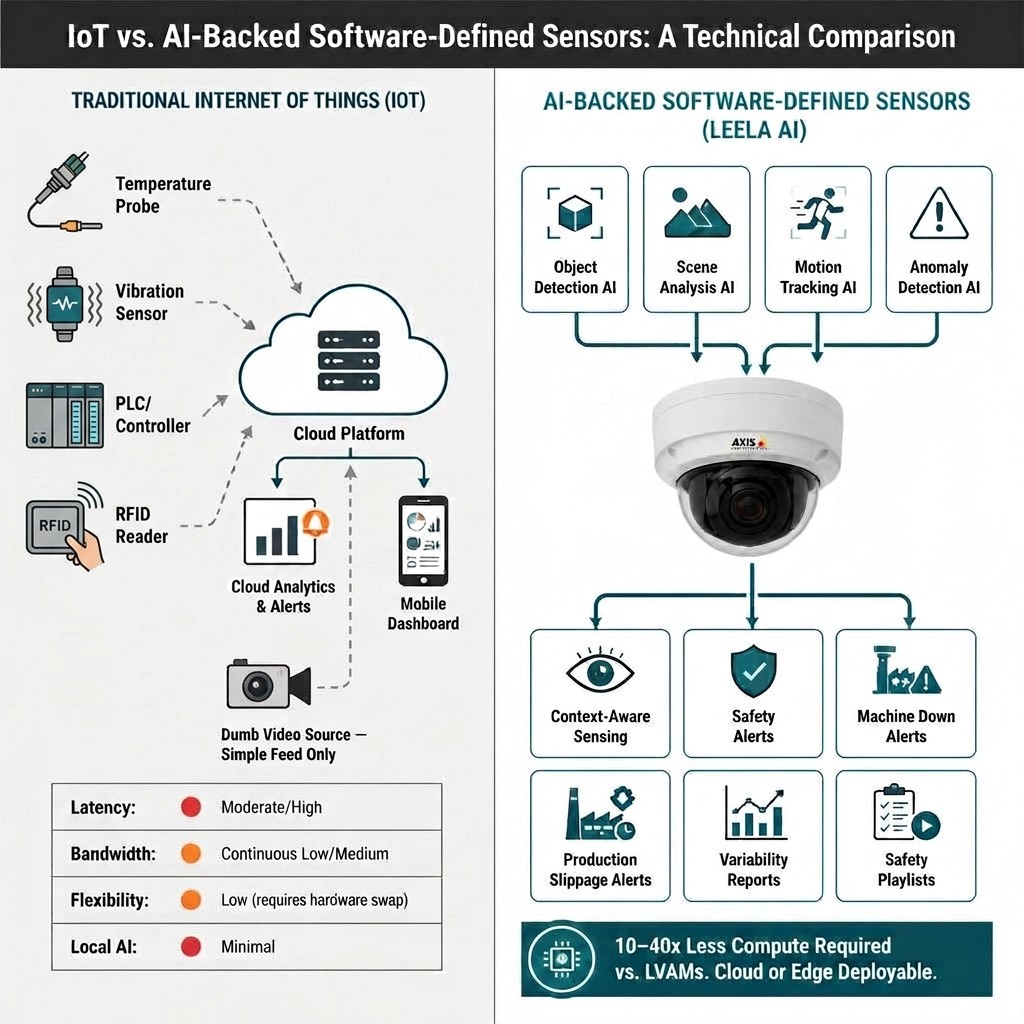
Compared to traditional industrial Internet of Things (IoT) sensors (like vibration, temperature, proximity, or magnetic sensors), Leela AI takes a different approach to factory-floor data collection. Instead of placing physical hardware on every machine, it treats existing video cameras as software-defined sensors.The core differences lie in deployment, detecting and measuring complex activity, and contextual data:
| Metric / Feature | Traditional IoT Sensors | Leela AI Platform |
|---|---|---|
| Data Source | Physical hardware attached to machines (e.g., proximity, thermal). | Existing or standard CCTV/Axis camera video feeds. |
| Primary Focus | Machine health, telemetry, and simple electronic outputs. | Interactions between machines, operators , product, material, vehicles |
| Installation & Cost | High; requires physical retrofitting, wiring, and machine downtime. | Low; purely software-based installation leveraging existing infrastructure. |
| Contextual Visibility | Tells you when a process or manual/machine interaction stops, but not why it stopped. | Tells you why by visually tracking bottlenecks, missed steps, safety, material flow, etc. |
| Scalability | Linear; tracking a new metric or machine requires buying a new sensor. | High; a single camera can track multiple metrics and stations at once. |
Key Advantages Over Traditional IoT
1. Tracking the ‘Invisible’ Un-instrumented operations and states on the floor: coordination between machines, operators, product, material, vehicles etc..
Traditional IoT sensors excel when a machine is automated, but they go completely dark on manual assembly lines, kitting stations, and packing areas. Leela AI fills this gap by acting like an automated time-and-motion study. It measures interactions and the state of machines, tools, operators, safety equipment, parts, and products—capturing manual cycle times that machine sensors cannot track.
2. Delivering Context, Not Just Raw Data
If a production line halts, a traditional IoT proximity sensor can log the precise second it stopped. However, it cannot tell you if the stoppage was caused by someone waiting for parts, a safety issue, or an unorganized workstation. Leela AI provides the visual context behind the data, helping managers identify the root causes of downtime.
3. Non-Invasive Deployment
Retrofitting a factory floor with traditional IoT hardware can be an operational headache that requires drilling into legacy equipment or stopping the line. Because Leela AI connects directly to standard visual data streams via software, it can be deployed incrementally—starting with one camera and scaling across hundreds of workstations without altering physical assets.
4. Complementary, Not Mutually Exclusive
Rather than replacing IoT, software like Leela AI is frequently integrated with industrial IoT platforms (such as Velotic ThingWorx and AVEVA). Combining machine telemetry (such as vibration/temperature) with visual analytics (human movement/flow) creates a comprehensive digital twin of a manufacturing floor.
Leela AI turns standard factory and warehouse cameras into smart sensors that analyze manufacturing and logistics operations.
Core Technology
-
- Leela Platform: Software that converts regular video feeds into actionable operational data without requiring manual tracking or extra hardware sensors.
- Leela’s Core Technology: An AI engine rooted in MIT research that uses a hybrid causal and neural network. It learns faster and uses significantly less data and compute than LVAMs.
- Leela Viewer: A dashboard that displays real-time key performance indicators (KPIs), time-coded video clips, and alerts.
Main Functions
-
- Time-and-Motion Tracking: Acts as a continuous study to measure cycle times, track workstation efficiency, and spot workflow bottlenecks.
- Quality Control: Detects missed production steps, out-of-order tasks, and equipment issues.
- Safety Monitoring: Identifies missing personal protective equipment (PPE) and flags unsafe activity.
- Category: Blog Post