
Edge Video Analytics for Manufacturing Sites (2026)

Most manufacturing sites already have cameras. They already generate video. And yet, the operational data locked inside those video streams rarely makes it into the systems that drive production decisions. The gap between what you can see on the floor and what your analytics actually capture is where productivity, safety, and capacity improvements stall. This is why we are sharing this whitepaper about the future of edge video analytics for manufacturing sites.

Whether you run a single plant or coordinate dozens of sites globally, the deployment architecture you choose determines whether video intelligence becomes an operational asset or an expensive pilot that never scales.
Key Takeaways: Edge Video Analytics for Manufacturing
- Edge deployments keep video data on-site, reducing long-term cloud costs and protecting sensitive operational information from external exposure.
- On-premises processing ensures your analytics keep running even when internet connectivity drops, preventing costly production blind spots.
- Local network integration with MES and ERP systems eliminates latency and simplifies data exchange between your visual intelligence and enterprise platforms.
- Leela AI Visual Intelligence Platform offers flexible cloud or edge server options, letting you match the deployment model to each site’s constraints.
- Data sovereignty and cybersecurity requirements increasingly favor on-premises architectures for manufacturing environments handling proprietary process data.
Why Do Manufacturing Video Analytics Projects Fail?
The failure rate for computer vision projects in manufacturing is high. According to a 2026 analysis by Roboflow, roughly 77% of vision AI implementations never make it past the pilot phase.
The technology itself usually works. What breaks is the deployment architecture, the integration path, and the assumptions about how data moves between the production floor and the systems that need it.
Three deployment-level failures account for most stalled projects. First, bandwidth limitations choke cloud-dependent architectures when you scale beyond a handful of cameras. Second, integration complexity between isolated video analytics and existing MES or ERP platforms creates data silos.
Third, change management stalls when frontline teams do not see timely, actionable results because inference latency or connectivity issues delay feedback.
These are not technology problems. They are architecture problems. Choosing the wrong deployment model for your site’s constraints turns a working pilot into an operational dead end.
What Is Edge Video Analytics and How Does It Differ from Cloud Processing?
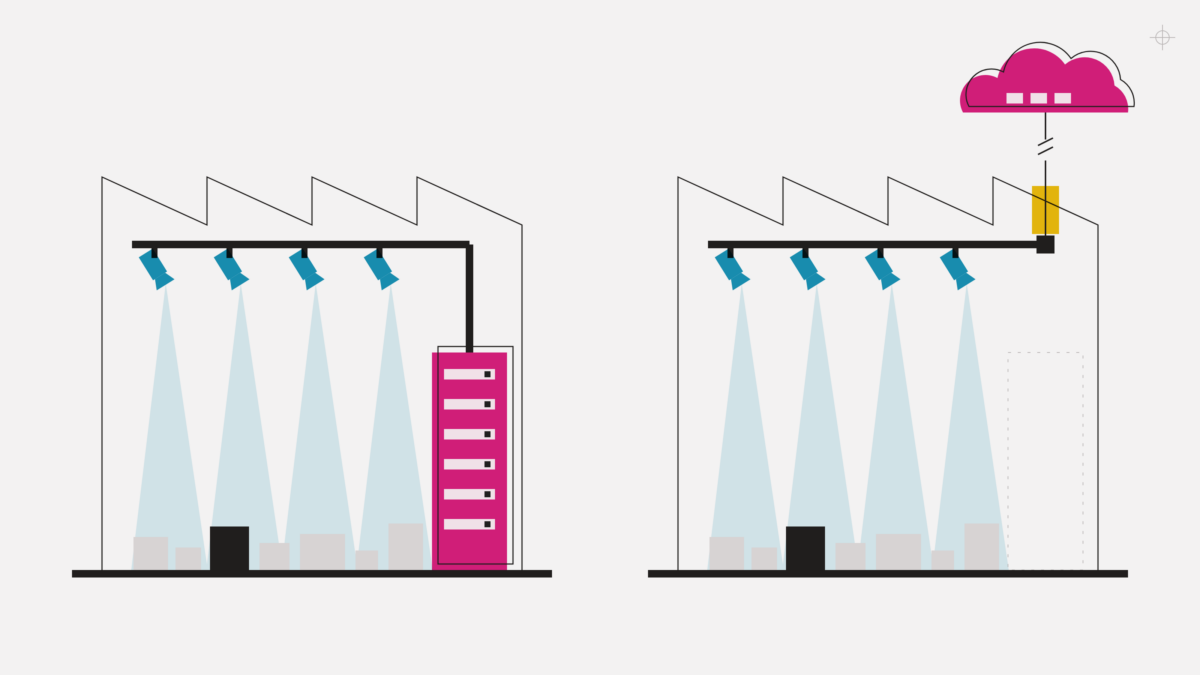
Edge video analytics processes video data on a server located at your manufacturing site, inside your facility’s network boundary. Cloud video analytics sends that same video data to an off-site data center for processing and returns results over the internet.
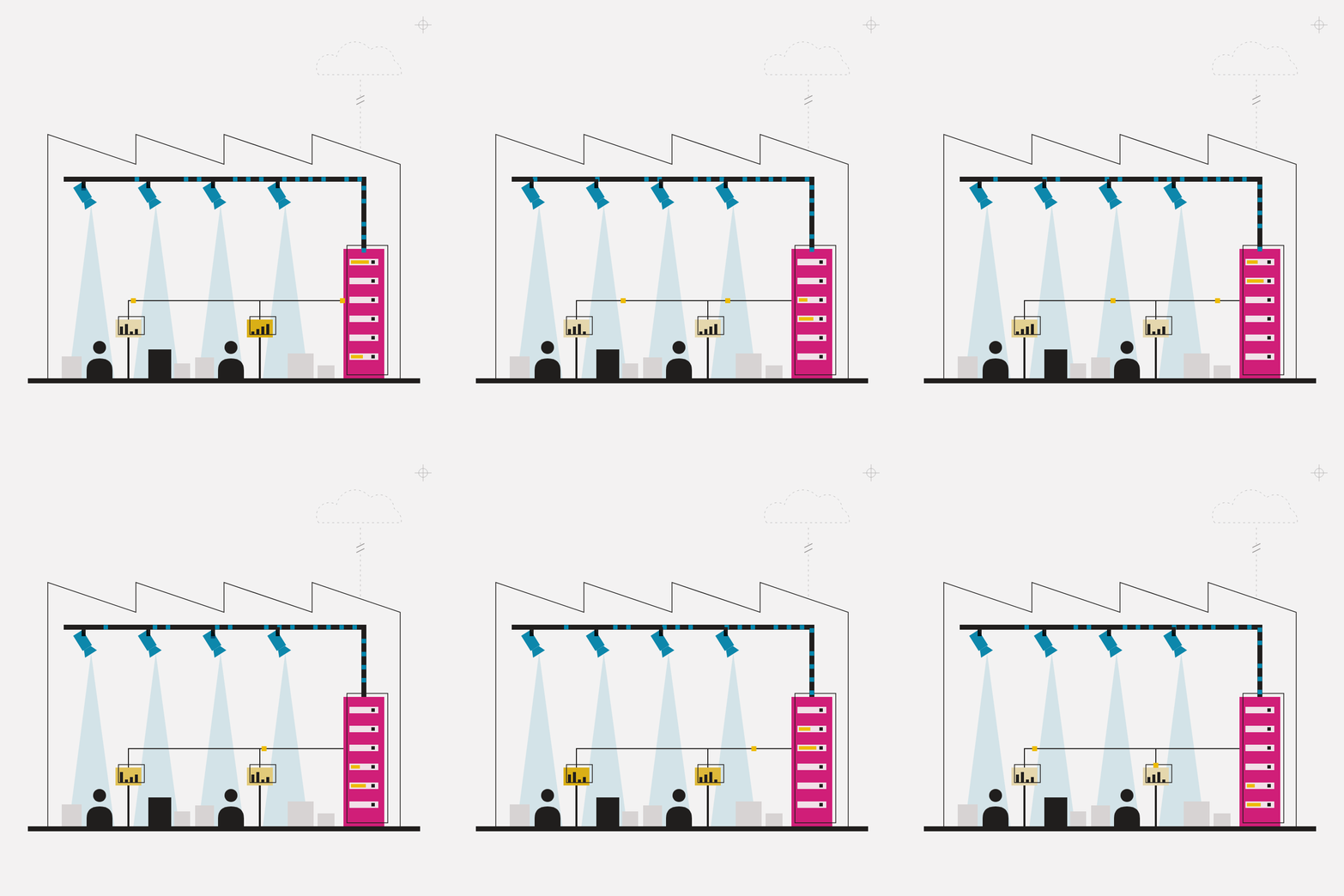
The practical difference comes down to where the compute happens. With edge processing, raw video never leaves your premises. The on-site server handles inference, generates metrics, and delivers results to your dashboard through your local network.
With cloud processing, video streams travel over your internet connection to a remote data center, get processed there, and the results travel back.
For manufacturing environments, this distinction has direct consequences for latency, bandwidth consumption, data security, and operational resilience. A cloud architecture works when camera counts are low and internet bandwidth is abundant. An edge architecture becomes necessary when either of those assumptions breaks down, which happens quickly as you scale beyond an initial pilot.
How Does Bandwidth Affect Video Analytics Deployment?
Video is heavy data. A single industrial camera streaming at standard resolution can generate gigabytes of data per shift. Multiply that by ten, twenty, or fifty cameras across a production facility, and the bandwidth requirement becomes a serious infrastructure constraint.
Cloud-dependent architectures require all that data to travel upstream over your internet connection. At bandwidth-constrained sites, common in manufacturing facilities located in industrial zones or rural areas, this creates a bottleneck that either degrades analytics quality or forces you to reduce camera coverage. Neither outcome delivers the operational visibility you need.
Edge processing eliminates this bottleneck. Video data stays on the local network, which typically has far greater capacity than your internet uplink. The only data that needs to travel externally, if any, is the lightweight analytics output: metrics, alerts, and summary data.
What Are the Economic Benefits of On-Premises Edge Deployments?
The cost comparison between edge and cloud deployments shifts decisively in favor of on-premises hardware as you scale cameras and extend the deployment timeline. Cloud video analytics follows a recurring cost model where you pay for compute, storage, and data transfer every month, and those costs grow proportionally with camera count and video volume.
On-premises edge hardware requires an upfront capital investment in a server appliance. After that initial purchase, your ongoing costs are limited to the software subscription, electricity, and occasional hardware maintenance. There are no per-gigabyte data transfer fees, no cloud compute charges that scale with usage, and no surprise costs when you add cameras.
Over a typical three-to-five-year deployment lifecycle, the total cost of ownership for edge processing is substantially lower than equivalent cloud processing for sites running more than a handful of cameras. A Mobile Experts analysis found that heavy industrial workloads at the edge can cost 35-55% less than equivalent cloud deployments over a three-year period.
How Does the Cost Equation Change as You Scale?
The economic advantage of edge widens with scale. Each additional camera in a cloud architecture adds recurring monthly costs for bandwidth, compute, and storage. Each additional camera in an edge architecture adds only the marginal cost of processing on hardware you already own, until you reach the server’s capacity threshold.
This means your cost per camera decreases as you add coverage. For a manufacturing operation running visual intelligence across twenty or more camera stations, the cumulative savings over cloud alternatives become significant enough to fund additional operational improvement initiatives.
Leela AI gives you the flexibility to start with a cloud deployment for initial evaluation and transition to an on-premises edge server as you scale. This approach lets you validate the platform’s value before committing to hardware investment, while preserving a clear path to lower long-term costs.
How Does On-Premises Deployment Protect Data Sovereignty?
Manufacturing video contains proprietary operational information. Cycle times, production sequences, staffing patterns, equipment layouts, and process techniques are all visible in production floor video. Sending that data to a cloud provider means your most sensitive operational intelligence leaves your physical control.
Data sovereignty requirements vary by jurisdiction, industry, and customer contract. Aerospace, defense, automotive, and pharmaceutical manufacturers often operate under regulations or contractual obligations that restrict where production data can be stored and processed.
Even where regulations do not mandate on-premises processing, many manufacturers prefer to keep operational video under their direct physical control as a matter of competitive risk management.
An on-premises edge deployment addresses these requirements by design. Video data is captured, processed, and stored entirely within your facility. No production footage travels over the public internet. No third-party cloud provider has access to your raw operational data. You maintain complete custody of every frame.
What Data Sovereignty Regulations Affect Manufacturing Video?
Several regulatory frameworks influence where and how manufacturing video data can be processed. ITAR restrictions in the United States govern facilities handling defense-related manufacturing. GDPR in Europe imposes requirements on video containing identifiable individuals. FDA 21 CFR Part 11 applies to pharmaceutical manufacturing environments. Industry-specific customer mandates often add additional data residency requirements.
Meeting these requirements with a cloud architecture typically means navigating complex data processing agreements, regional cloud availability zones, and compliance audits. An on-premises edge deployment simplifies compliance by keeping all data within your facility’s physical and network boundaries, reducing the regulatory surface area you need to manage.
Leela AI Visual Intelligence Platform ships with rigorous SOC 2 Type II certification and the widest range of privacy options in the category. These include face and body blurring, an option to make pre-blur images unrecoverable, and the ability to disable video storage entirely.
Combined with on-premises edge deployment, these controls give you a comprehensive data governance posture.
Why Is Cybersecurity Stronger with On-Premises Edge Processing?
Every time data leaves your facility and travels over the internet, it crosses network boundaries that introduce potential exposure points. Cloud architectures create a continuous data flow between your production floor and an external data center. That flow must be encrypted, authenticated, and protected against interception, which adds complexity and attack surface.
On-premises edge processing keeps your video data entirely within your facility’s network perimeter. The attack surface shrinks because the data never traverses the public internet. Your existing industrial network security controls, firewalls, segmentation, and access management apply directly to your video analytics infrastructure without the need for additional cloud-specific security layers.
This matters particularly for operational technology (OT) environments. Manufacturing networks are increasingly targeted by cyberattacks. According to Deloitte’s 2025 Smart Manufacturing survey of 600 executives, cybersecurity is among the top concerns for manufacturers implementing smart factory technologies. Keeping video analytics processing on-premises reduces one of the most significant vectors: external data transit.
How Does Air-Gapped Operation Enhance Security?
Some manufacturing environments require fully air-gapped networks that have no connection to the public internet. Defense contractors, certain pharmaceutical operations, and facilities handling classified processes fall into this category. Cloud-based analytics cannot function in these environments at all.
An on-premises edge deployment can operate in a fully air-gapped configuration. The visual intelligence platform processes video, generates analytics, and delivers results through the local network without any external connectivity requirement. This makes visual intelligence accessible to the most security-sensitive manufacturing operations.
How Does Local Network Integration Simplify MES and ERP Connectivity?
Your MES tracks production orders, routing, and quality data. Your ERP manages planning, inventory, and scheduling. Your visual intelligence platform generates the operational metrics that both systems need but neither can capture on its own. When all three systems sit on the same local network, integration becomes straightforward.
On-premises edge deployment places your video analytics server on the same network as your MES and ERP systems. Data exchange happens over local connections with minimal latency and no dependence on external connectivity.
An MQTT API or similar protocol pushes metrics directly from the visual intelligence platform to your MES or ERP in near real time, without routing through an external cloud.
Leela AI supports integration via MQTT API with IIoT, MES, ERP, and other enterprise platforms. When deployed on-premises, these integrations operate entirely within your local network. This eliminates the latency, reliability, and security complications that come with cloud-mediated data exchange between plant-floor systems.
What Are the Benefits of Local Data Exchange?
Local integration delivers three operational advantages. First, latency drops from hundreds of milliseconds (typical for cloud round trips) to single-digit milliseconds on a local network. For time-sensitive production feedback, this difference determines whether alerts arrive before or after a problem has already propagated down the line.
Second, reliability improves because local network connections are not subject to internet outages, ISP throttling, or the cascading failures that can affect cloud services. Your MES receives visual intelligence data as long as the local network is up, regardless of what is happening with your internet connection.
Third, configuration and troubleshooting are simpler. Your IT and OT teams can manage the entire data flow with tools and expertise they already have. There are no cloud networking layers, API gateways, or cross-account permissions to debug when something stops working.
How Does Edge Deployment Provide Operational Resilience?
Internet connectivity at manufacturing sites is not guaranteed. Industrial facilities experience outages from weather events, ISP maintenance windows, construction accidents that sever fiber lines, and the general unreliability of broadband in many industrial zones. When your video analytics depend on a cloud connection, an internet outage means a total loss of operational visibility.
On-premises edge processing decouples your analytics from internet availability entirely. If your internet connection drops for an hour, a day, or a week, your visual intelligence platform keeps running. Cameras keep feeding data to the local server.
The server keeps processing video, generating metrics, and delivering results to your dashboard through the local network. Your production team never loses access to the data they need to make decisions.
This resilience is not a theoretical benefit. Manufacturing sites in rural or semi-rural areas routinely experience internet disruptions. For operations running around the clock, even a few hours of lost visibility can obscure the root cause of a production issue that costs far more than the analytics infrastructure itself.
What Happens to Data During an Internet Outage?
With a cloud-dependent architecture, an internet outage creates a gap in your data. Video captured during the outage either goes unprocessed or must be uploaded and processed after connectivity returns, creating a backlog that delays insights and may exceed your cloud storage allocation.
With an on-premises edge deployment, there is no data gap. Processing continues uninterrupted because the entire analytics pipeline runs locally. Metrics flow into your operations dashboard in near real time throughout the outage.
When connectivity returns, any summary data destined for a central corporate system can sync automatically. Your plant-level operations never missed a beat.
Step-by-Step: How to Deploy Video Analytics on Bandwidth-Constrained Manufacturing Sites
Deploying video analytics at a site with limited bandwidth requires deliberate architectural choices. Skipping the planning steps below is how working pilots become stalled projects. Each step includes the action and the reason it matters.
Step 1: Assess Your Site’s Bandwidth and Network Topology
Map your available internet bandwidth, internal network capacity, camera count, and the physical locations where cameras will be installed. Measure actual available bandwidth during peak production hours, not the theoretical maximum your ISP advertises. This assessment determines whether cloud, edge, or hybrid processing is the right starting point for your site.
Step 2: Define Your Data Residency and Security Requirements
Identify regulatory constraints, customer contractual obligations, and internal policies that govern where production video can be stored and processed. Document whether your facility requires air-gapped operation, on-premises-only storage, or permits cloud processing under specific conditions. These requirements eliminate some deployment options entirely and narrow your architecture choices.
Step 3: Choose Your Deployment Architecture
Based on your bandwidth assessment and data requirements, select an architecture. For bandwidth-constrained sites or those with strict data residency requirements, an on-premises edge deployment is typically the correct choice. For sites with abundant bandwidth and no data restrictions, cloud may be simpler initially.
A hybrid approach works well for multi-site operations. You process locally and send only lightweight summary data to a central cloud, giving each plant local autonomy while maintaining corporate-level reporting.
Step 4: Pilot with a Focused Scope
Start with a small number of cameras on one or two production lines that represent your most pressing operational visibility gap. Choose a pilot area where you already know bottlenecks exist but lack the data to quantify them. This focuses the evaluation on demonstrating measurable value rather than testing the technology in isolation.
Leela AI requires 100x less training data than typical solutions, with AI training completed in as little as a week using 3 to 10 smartphone-recorded video clips per camera station. That makes a focused pilot practical and fast.
Step 5: Integrate with Existing Systems
Connect your visual intelligence platform to your MES, ERP, and any IIoT platforms already in use. On an edge deployment, this integration happens over your local network using standard protocols.
Plan this integration during the pilot, not after. The value of video analytics multiplies when the data feeds directly into the systems your operations team already uses for decision-making.
Step 6: Scale Incrementally
Add cameras and coverage area based on the value demonstrated in the pilot. Each expansion should target a specific operational gap: a second shift, a parallel production line, or an adjacent work area.
Leela AI lets you start with a single camera and expand incrementally, fusing data from multiple cameras on a single workstation and comparing visual data from hundreds of cameras across multiple sites.
Step 7: Invest in Change Management
Technology is usually the easy part. Getting people to change how they work based on new information is harder. Establish routines for reviewing visual intelligence data and making operational changes. Share the dashboard from the front office to the front line so everyone can see the same ground truth.
Use privacy-first controls like face and body blurring to build trust with frontline staff. The operational value only materializes when teams act on the data consistently.
How Do Edge and Cloud Architectures Compare for Video Analytics?
The choice between edge and cloud is not binary. Each architecture has specific strengths, and the right answer depends on your site’s constraints. The comparison below covers the dimensions that matter most for manufacturing operations.
Latency is lower with edge processing because data does not travel off-site. For applications requiring near-real-time feedback, such as flagging safety hazards or detecting production anomalies, edge processing delivers results in seconds rather than the variable latency of a cloud round trip.
Bandwidth consumption is dramatically lower with edge processing. Only lightweight metrics and alerts need to leave the site, compared to continuous high-volume video streams for cloud processing. This is the deciding factor for bandwidth-constrained manufacturing sites.
Data security is inherently stronger with edge processing because video never leaves your network perimeter. Cloud processing requires encrypting, transmitting, and securing data across multiple network boundaries.
Scalability has trade-offs in both directions. Cloud architectures scale compute capacity on demand without hardware purchases. Edge architectures require server hardware investment but deliver lower per-camera costs at scale and eliminate recurring cloud charges.
Operational resilience favors edge processing. Your analytics continue running regardless of internet connectivity status. Cloud architectures create a single point of failure at your internet connection.
What Role Do Chat-Based Video Assistants Play in Operational Visibility?
Collecting video analytics data is only half the challenge. The other half is making that data accessible and actionable for operations leaders who do not have time to navigate complex dashboards or write queries.
Chat-based video assistants sit on top of a visual intelligence platform and let you ask questions about your operations in natural language. Instead of drilling through menus and filters, you can ask direct questions.
What caused the throughput drop on Line 3 during second shift? How does Station 2’s cycle time compare to Station 4 over the last month? Are PPE compliance rates improving in the welding area? These are the kinds of queries that a chat-based assistant answers from your operational data.
Leela AI for Ops is a chat-based assistant that uses Leela AI’s Visual Intelligent Agents for automatically analyzing manufacturing operations. It works with the Leela Viewer dashboard to make comparing data on performance across shifts and locations, identifying trends, and helping to identify root causes for production slippage and safety issues straightforward through natural language.
This interaction model is particularly valuable in edge deployments where the assistant runs locally alongside the analytics engine. When all the data and the interface to query it are on your local network, response times are fast and the system remains available even during internet outages.
How to Evaluate Video Analytics Platforms for Manufacturing Deployment
Ask vendors specific questions before committing to a deployment. These evaluation criteria apply to the category, not only to any single platform.
First, ask about deployment flexibility. Can the platform run on-premises, in the cloud, or in a hybrid configuration? Manufacturing sites have diverse infrastructure constraints, and a platform that only supports one deployment model will not scale across your facilities.
Second, ask about training data requirements and time-to-value. How many labeled images or video clips does the platform need before it delivers useful results? How long does the training cycle take? Platforms that require hundreds of hours of image labeling are expensive to deploy and slow to adjust when production conditions change.
Third, ask about integration with existing systems. Does the platform support standard protocols like MQTT for pushing data to your MES and ERP? Can it function as a standalone system while also supporting deeper integration?
Leela AI’s hybrid causal and neural AI architecture delivers rapid training with small datasets alongside a far greater scope of operational measurement. The platform can deliver significant value standalone or integrated via API with your existing manufacturing software.
Fourth, ask about privacy safeguards. What options exist for face blurring, body blurring, and disabling video storage? How are these controls implemented and verified? For manufacturing environments, privacy-first design is the mechanism that enables frontline acceptance and therefore makes deployment possible.
Fifth, ask about accuracy, and ask how accuracy rates are measured. Request references from manufacturing environments similar to yours. Be skeptical of claims that are not backed by customer examples.
In Conclusion: Choosing the Right Video Analytics Architecture for Your Manufacturing Site
The deployment architecture you choose for video analytics shapes every downstream outcome: cost trajectory, data security posture, regulatory compliance, system integration complexity, and operational resilience. For bandwidth-constrained manufacturing sites, and for any facility where data sovereignty, cybersecurity, or internet reliability are concerns, on-premises edge processing delivers clear and compounding advantages over cloud-only alternatives.
The long-term total spend is lower because you eliminate recurring cloud compute and data transfer charges. Your data stays under your physical control. Your analytics keep running when the internet does not.
Your visual intelligence platform integrates with your MES and ERP systems over a local network, with the speed and reliability that plant-floor operations demand.
The question is no longer whether visual intelligence will become standard in manufacturing. It is whether your operation will adopt it with an architecture that supports long-term operational success.
FAQs About Edge Video Analytics for Manufacturing
What is edge video analytics in manufacturing?
Edge video analytics processes production floor video on a server located inside your manufacturing facility rather than sending it to a remote cloud data center. This keeps data on-site, reduces latency, and ensures analytics continue operating even during internet outages.
Why is on-premises processing more cost-effective long term?
Cloud video analytics charges recurring fees for compute, storage, and data transfer that grow with camera count. On-premises edge hardware requires upfront investment but eliminates those recurring charges. Over three to five years, total cost of ownership for edge deployments is substantially lower, particularly for sites running many cameras.
How does Leela AI support edge deployment for manufacturing?
Leela AI Visual Intelligence Platform offers flexible cloud or edge server options. The on-premises deployment keeps all video processing and storage inside your facility. Leela AI requires 100x less training data than typical solutions and can generate actionable analytics within one to three weeks of setup, making edge deployment practical even at bandwidth-constrained sites.
Can video analytics systems integrate with MES and ERP on a local network?
Yes. When deployed on-premises, video analytics platforms communicate with MES and ERP systems over your local network using standard protocols like MQTT. This delivers lower latency, higher reliability, and simpler troubleshooting compared to cloud-mediated integration.
What happens to video analytics during an internet outage?
With on-premises edge processing, nothing changes. Cameras continue feeding data to the local server, which keeps processing video and delivering results through the local network. Your operations team retains full visibility. Cloud-dependent architectures lose all analytics capability until connectivity is restored.
How does on-premises deployment improve cybersecurity?
On-premises edge processing keeps video data entirely within your facility’s network perimeter. This eliminates the attack surface created by transmitting sensitive production footage over the public internet. Leela AI adds SOC 2 Type II certification and comprehensive privacy controls including face and body blurring to further strengthen your security posture.
Thanks for reading our guide to Edge Video Analytics for Manufacturing Sites (2026).